11.11 Explained for Brand Owners: How the Season Works, How Shoppers Decide, What to Prepare
Singles' Day is now a season of several weeks across Tmall, JD, Douyin and Xiaohongshu. Here is how the 2026 calendar is built, how consumers research before they buy, and what brands should have in place before it opens.
A short guide for brand owners to China's biggest shopping season: what 11.11 is, how the 2026 season works across Tmall, JD, Douyin and Xiaohongshu, how shoppers research before they buy, and what to prepare before it opens.
Watch the video on LinkedIn
Read it as a LinkedIn article
What is 11.11?
11.11, or Singles' Day, falls on 11 November. Students in China began marking the date as a day for single people in the 1990s; the story most often told traces it to Nanjing University in 1993, and the date was chosen because 11/11 looks like four ones. In 2009, Alibaba's Tmall held the first 11.11 sale. It has since grown into the world's largest online shopping event, and today all of China's major e-commerce platforms take part.
11.11, also called Singles' Day or Double 11, is the largest shopping event in China's year. It started as a one-day sale on Tmall in 2009. Today it runs for several weeks, across almost every major platform, and much of the buying decision is made well before 11 November.
This piece walks through how the 2026 season is structured, how consumers research and buy, and what brands can prepare in advance.
The scale of the season
Syntun, a third-party data firm that tracks the event every year, reported total 11.11 GMV of RMB 1.695 trillion in 2025, up 14.2% year on year. In 2024 it reported RMB 1.4418 trillion, in 2023 RMB 1.1386 trillion and in 2022 RMB 1.1154 trillion.
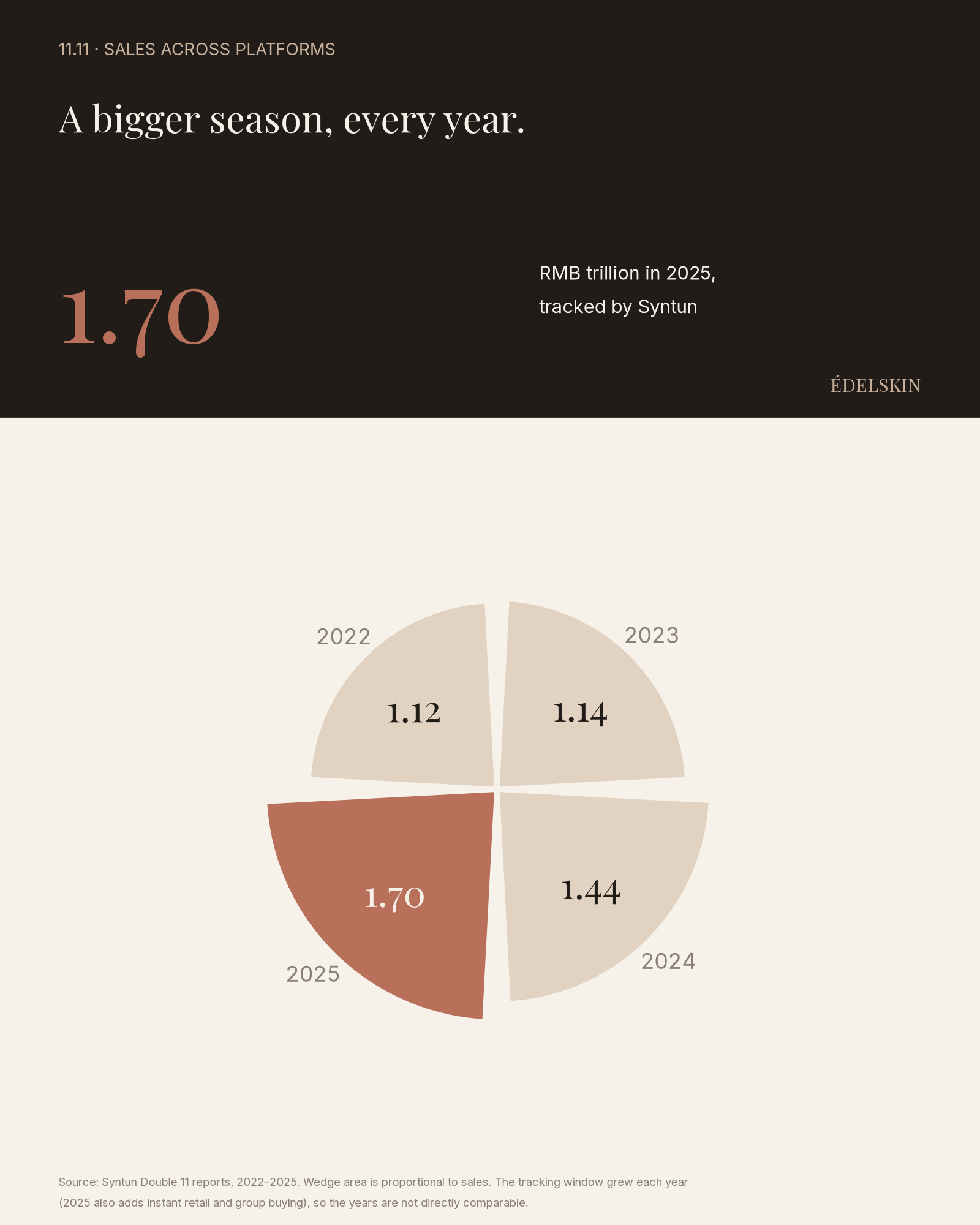
A bigger season, every year: 11.11 sales across platforms, RMB trillion. Wedge area is proportional to sales. Source: Syntun. The tracking window grew each year and 2025 adds instant retail and group buying, so the years are not directly comparable.
Part of that growth comes from a longer season. Syntun's 2024 window started on 14 October; in 2023 it started around 31 October. The steady signal is less the headline number and more how early the season now begins.
1. How the 2026 season is structured
Each platform sets its own calendar. For 2026, the published timings are:
- Xiaohongshu runs its first full Double 11 event ("1年1度购物狂欢") from 10 October to 11 November, after a warm-up from 24 September. It has two "burst" weeks (19–25 October and 26 October–1 November) and a final push from 2 to 11 November.
- JD opened spot sales on 12 October at 20:00, with no presale, and a second opening on 20 October. The event runs to 13 November.
- Tmall and Taobao keep the classic two-step model. Presale deposits opened on 15 October at 20:00 and close on 20 October; final payments run from 20 October at 20:00 to 25 October. Spot sales run from 20 October to 13 November.
- Douyin opened on 15 October for 28 days to 11 November, with no presale. Its focus days are 15–18 October and 7–11 November.
- WeChat Store is also running its first Double 11, from 12 October to 15 November.
Across platforms, the peak is the evening of 10 November from 20:00 through 11 November.
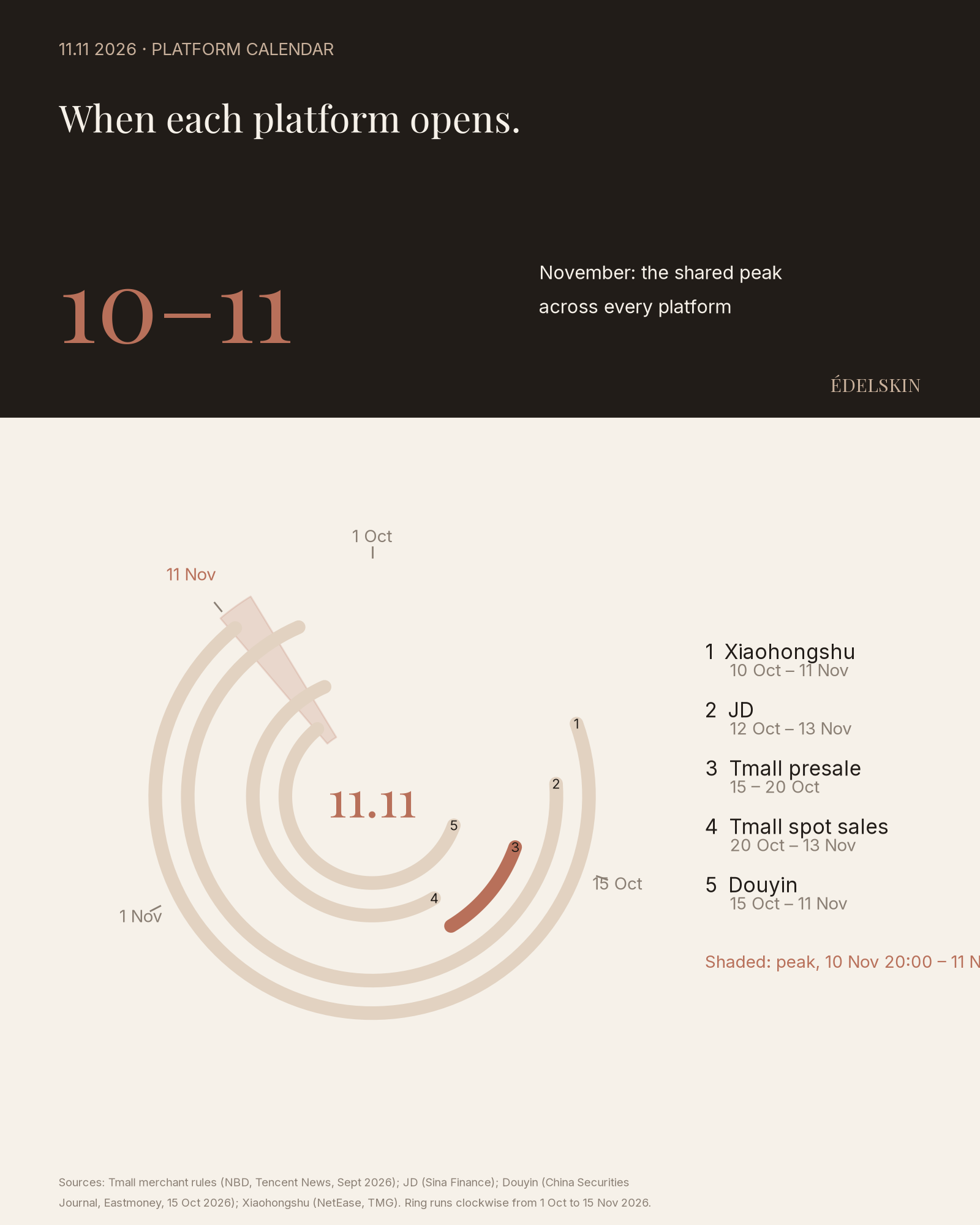
When each platform opens: 2026 sales windows on a clockwise ring from 1 October to 15 November, with the shared peak shaded. Sources: Tmall merchant rules (NBD, Tencent News); JD (Sina Finance); Douyin (China Securities Journal, Eastmoney); Xiaohongshu (NetEase, TMG).
A clear trend this year: several platforms are moving away from presale toward direct spot sales, with simpler single-item discounts.
2. How consumers research and buy
For beauty and wellness, the purchase usually starts weeks before payment.
Reviews come first. In a March 2025 survey of 2,036 people by China Youth Daily's Social Survey Centre and wenjuan.com, 90.6% said they read product reviews before buying online. 42.0% compare reviews of the same product across several platforms, and 39.7% read related posts on community e-commerce platforms.
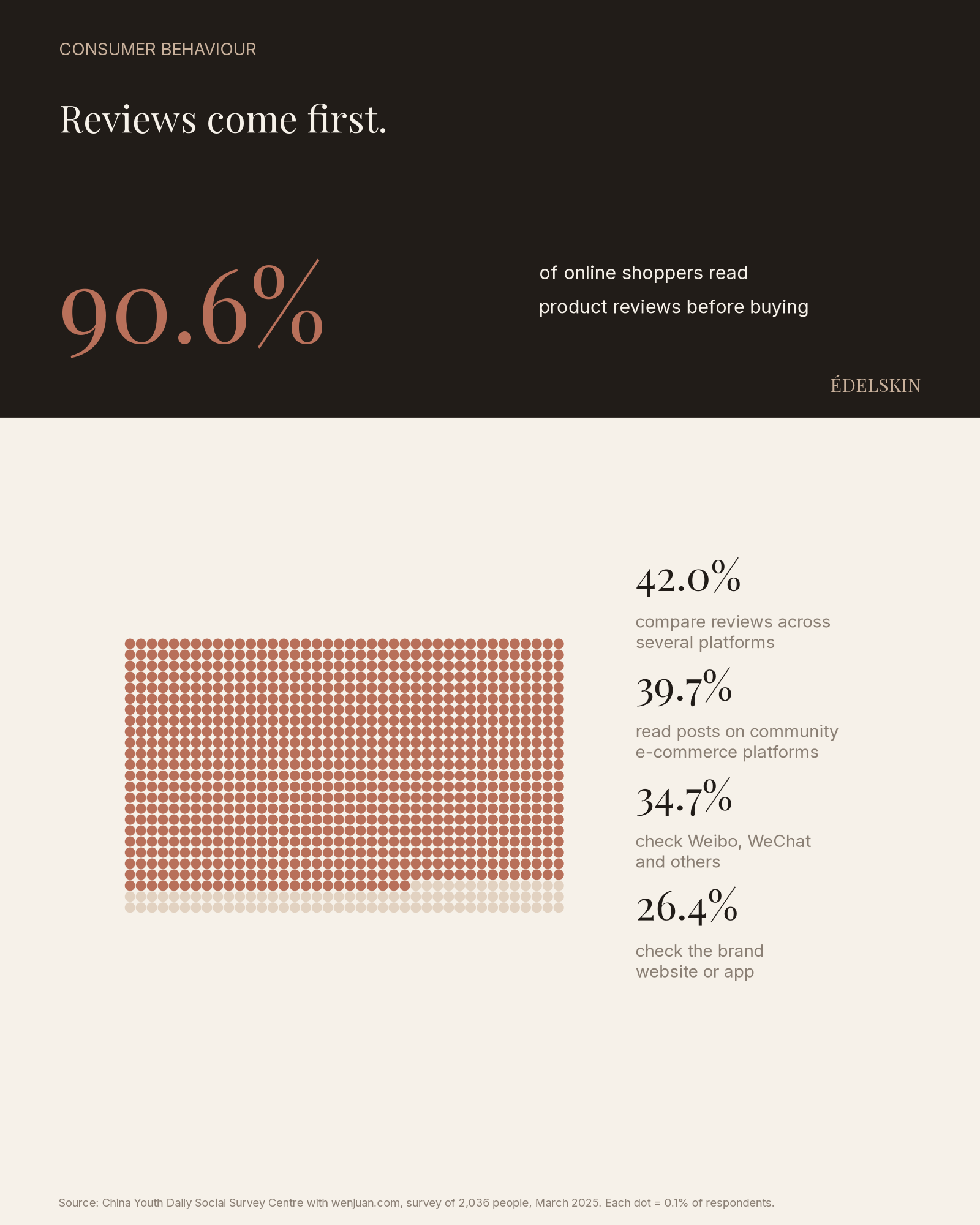
Reviews come first: each dot is 0.1% of respondents; 906 of 1,000 dots show the 90.6% who read reviews before buying. Source: China Youth Daily Social Survey Centre / wenjuan.com, March 2025, multiple answers.
Saving and shortlisting. On Xiaohongshu, shoppers save notes, compare routines and build lists ahead of the season. This is why the platform opens its warm-up in late September.
Comparing ingredients. Ingredient-focused shoppers ("成分党") read formulas side by side. China's E-commerce Research Center (100EC) linked this trend to growth in efficacy skincare sold through livestreams during 11.11 2025.
Livestreams. Livestreams let people see a product used and explained in real time. Syntun reported livestream sales of RMB 332.5 billion during 11.11 2024, up from RMB 215.1 billion in 2023 (with a longer 2024 window). 100EC reported beauty and personal care livestream GMV above RMB 115 billion during 11.11 2025, up 25.8%.
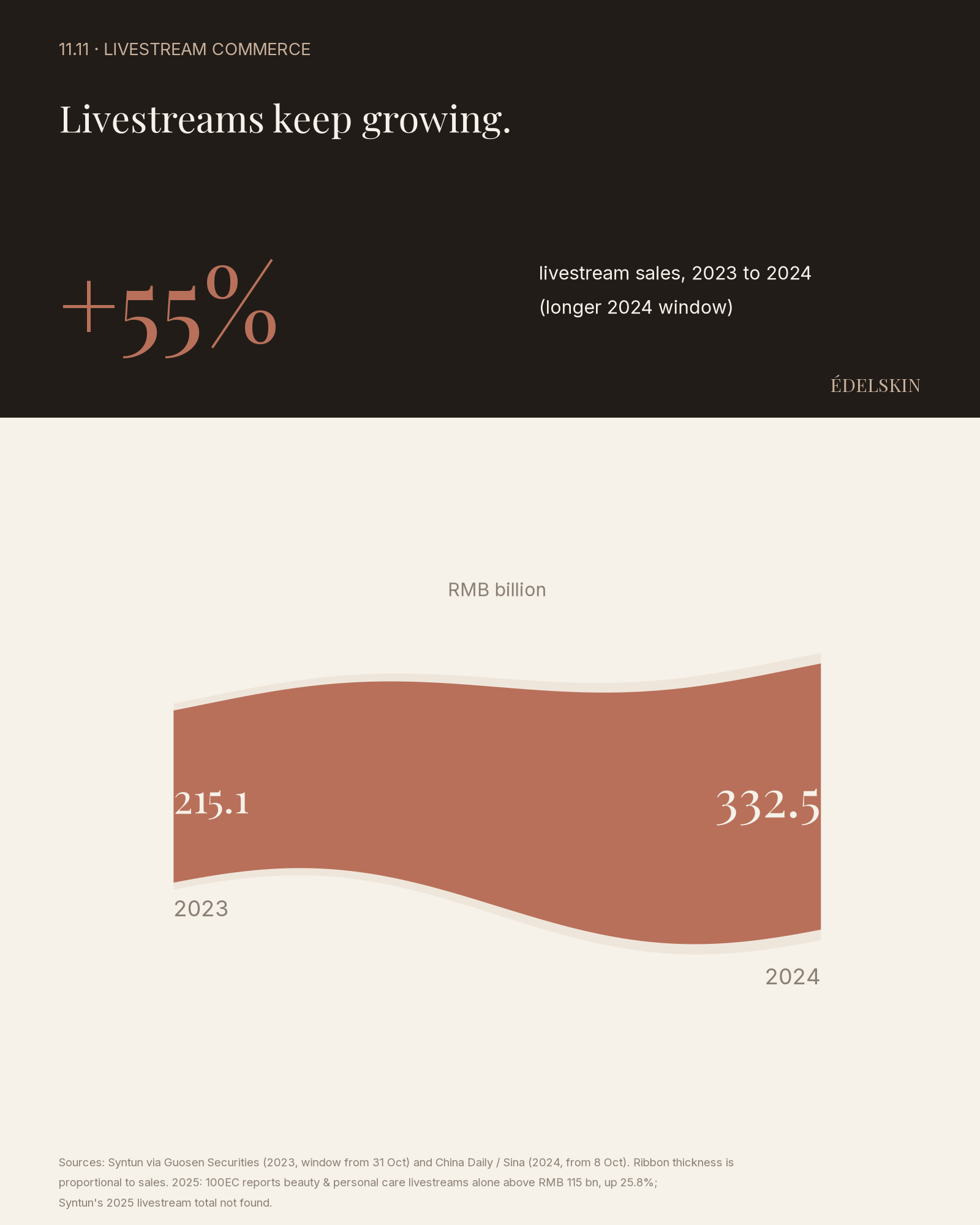
Livestreams keep growing: ribbon thickness is proportional to 11.11 livestream sales, RMB billion. Source: Syntun (2023 window from 31 October; 2024 from 8 October). 2025 beauty-only figure from 100EC.
3. Where beauty sits
Syntun reported that beauty and personal care made up 8.2% of 11.11 2025 GMV, about RMB 139 billion. Skincare led with RMB 99.1 billion, followed by personal care and cleaning (RMB 44.4 billion) and fragrance and makeup (RMB 33.4 billion).
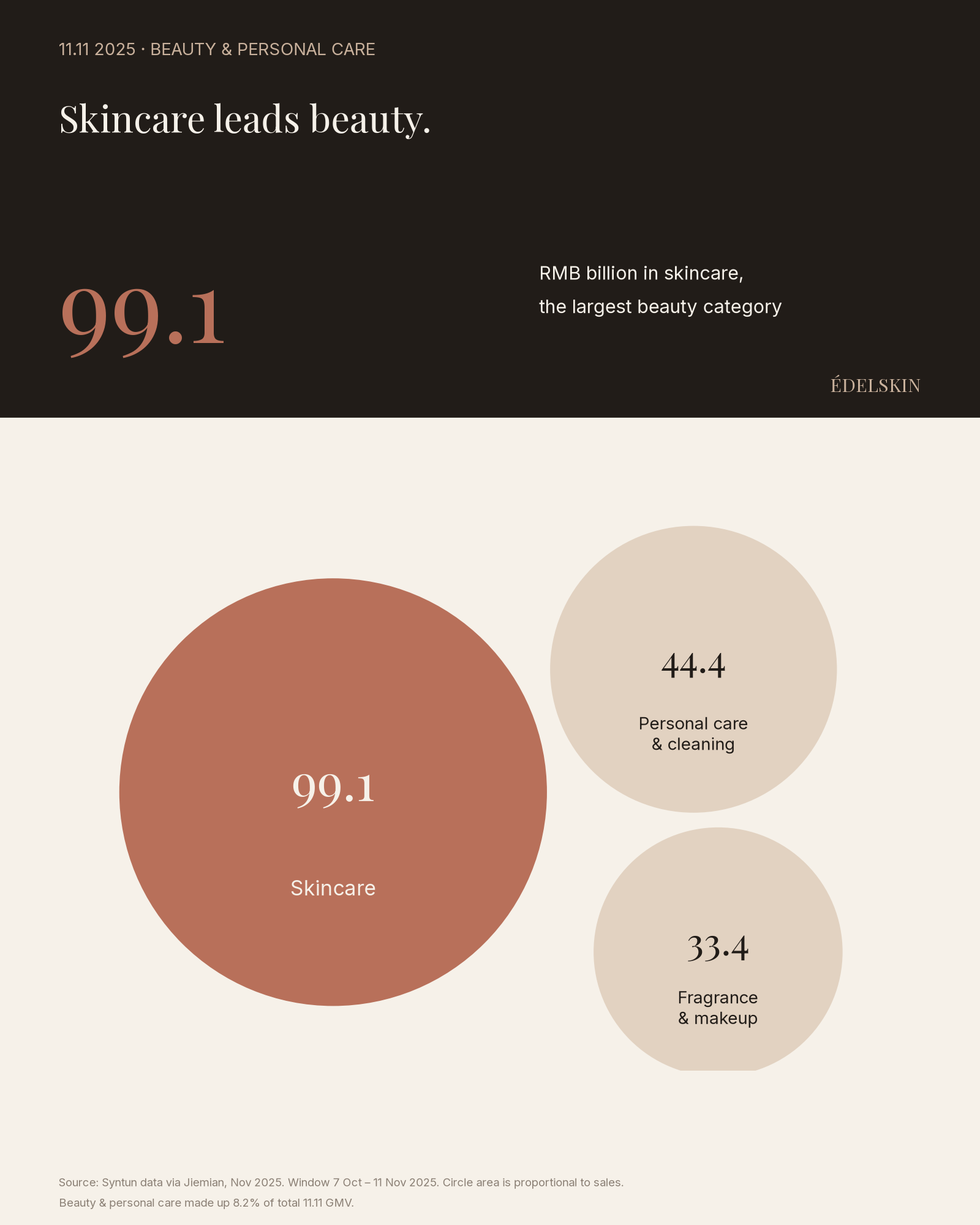
Skincare leads beauty: circle area is proportional to 11.11 2025 sales by category, RMB billion. Source: Syntun data via Jiemian, November 2025.
4. What brands should prepare beforehand
Because so much is decided early, most of the work happens before the season opens:
- Content and reviews in place. Product pages, notes and reviews should be live while shoppers are still researching, ideally from the warm-up phase.
- Ingredients explained clearly. Name the key ingredients and say what they do in simple words, on every page and in every livestream.
- Livestream partners briefed. Hosts should know the product well enough to answer real questions on air.
- Platform calendars mapped. Each platform has different dates and mechanics, so plan launches and promotions for each one.
- Stock, delivery and service ready. Demand concentrates around the final days, and customer service and delivery shape the reviews that follow.
One date in a series
11.11 is one of several dates that shape the shopping year in China. 38 Women's Day (8 March), 520 (20 May), 618 (June) and Chinese New Year each bring their own consumer behaviour.
618 gives a sense of scale. Syntun counted RMB 934.0 billion in sales across platforms during 618 2026 (13 May to 18 June), up 4.0% on the same window in 2025. Beauty was softer: skincare reached RMB 42.5 billion (down 1.6%) and fragrance and makeup RMB 13.6 billion (down 4.9%), after a very strong 2025.
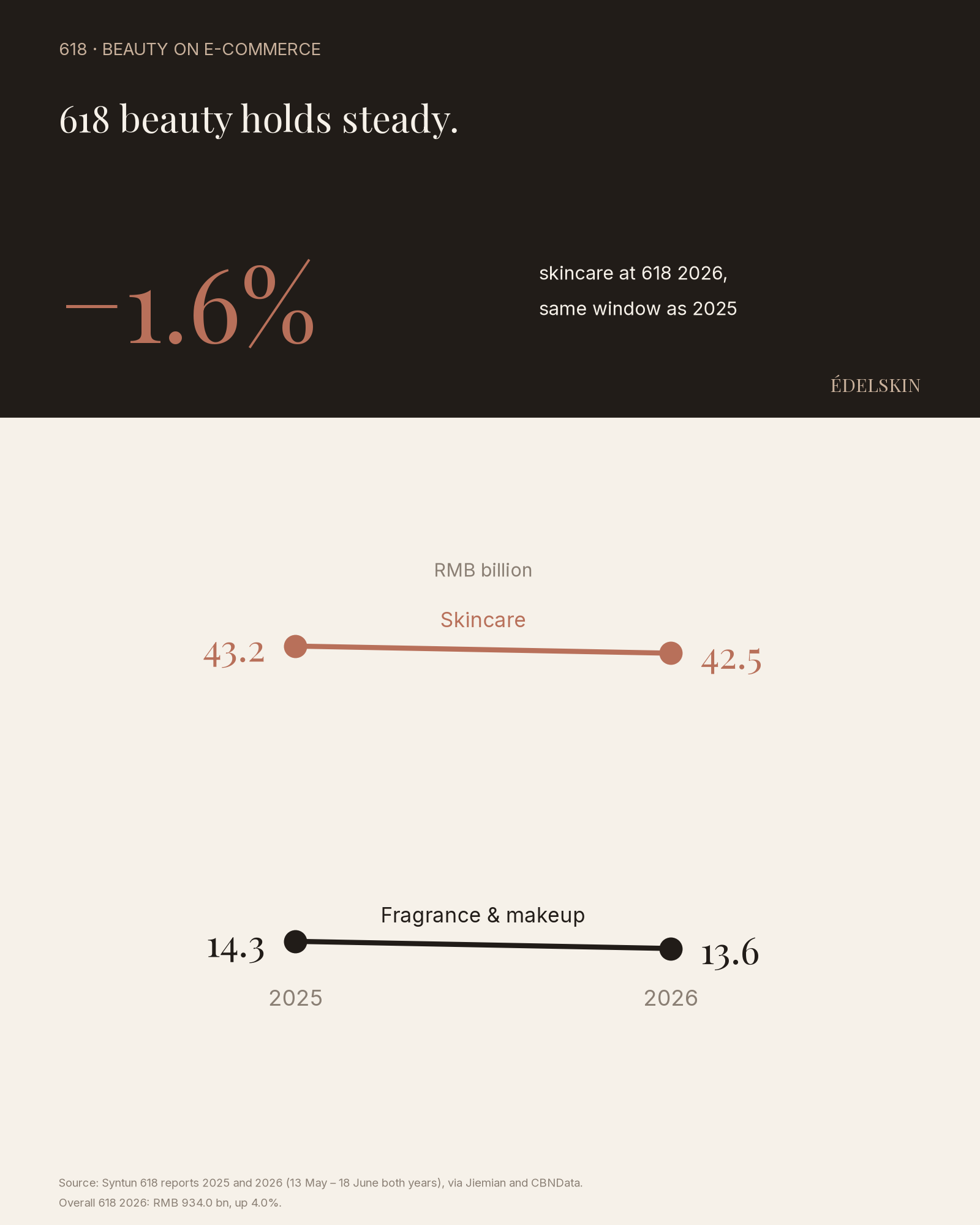
618 beauty holds steady: skincare and fragrance & makeup sales, 13 May – 18 June, 2025 vs 2026, RMB billion. Source: Syntun 618 reports via Jiemian and CBNData.
We'll look at each of these dates in the coming months.
Our view
Shoppers arrive at 11.11 already informed. The brands that do well tend to plan the season early, show up where people research, explain what makes the product work and are ready for the peak.
At ÉDELSKIN, we are an international commercialization company helping beauty, wellness and healthcare brands enter and grow in China and selected Asian markets. We sell direct to consumers with a dedicated team close to the market, our own technology and deep commercial expertise.
Data notes: figures come from third-party trackers and surveys cited above; platforms no longer publish official 11.11 totals. Full source list available on request.