Beauty's Centre of Gravity Is Moving
Global beauty is growing slowly, but India, Southeast Asia and other emerging markets are growing much faster and increasingly online, and European brands that want to follow need more than a route to market.
For most of the past few decades, the beauty industry's map has been easy to read. Its biggest markets were its most important ones, and growth came from selling more into places that already bought a lot. That map is starting to change. Not all at once, and not dramatically, but steadily enough that brands planning their next five years should pay attention.
A slow market with fast pockets
Global beauty and personal care grew 2.5% in real terms in 2026, reaching USD 647bn, after 2.0% in 2025. That's healthy for a category this mature, but it isn't the kind of growth that changes a brand's trajectory on its own.
The more interesting detail sits underneath the headline. According to Euromonitor, emerging markets are leading that growth. The global average hides a split between mature markets that are inching forward and younger ones that are moving several times faster. For a brand, the average is less useful than knowing where the fast pockets are.
Where the growth actually is
Southeast Asia is one of the clearest examples. Euromonitor forecasts the region to grow 4.4% a year between 2026 and 2030, about three times the rate of mature East Asian markets. The drivers are structural rather than cyclical: young populations, rising spending on self-care, and a consumer who discovers, compares and buys online as a matter of course.
India tells a similar story from a different angle. L'Oréal India is growing at around 18%, against roughly 10% for the Indian market as a whole, and is expected to pass €1bn in sales before 2030. A market growing at 10% is attractive by any measure. A well-run brand growing nearly twice as fast inside it shows what's possible when the execution matches the opportunity.
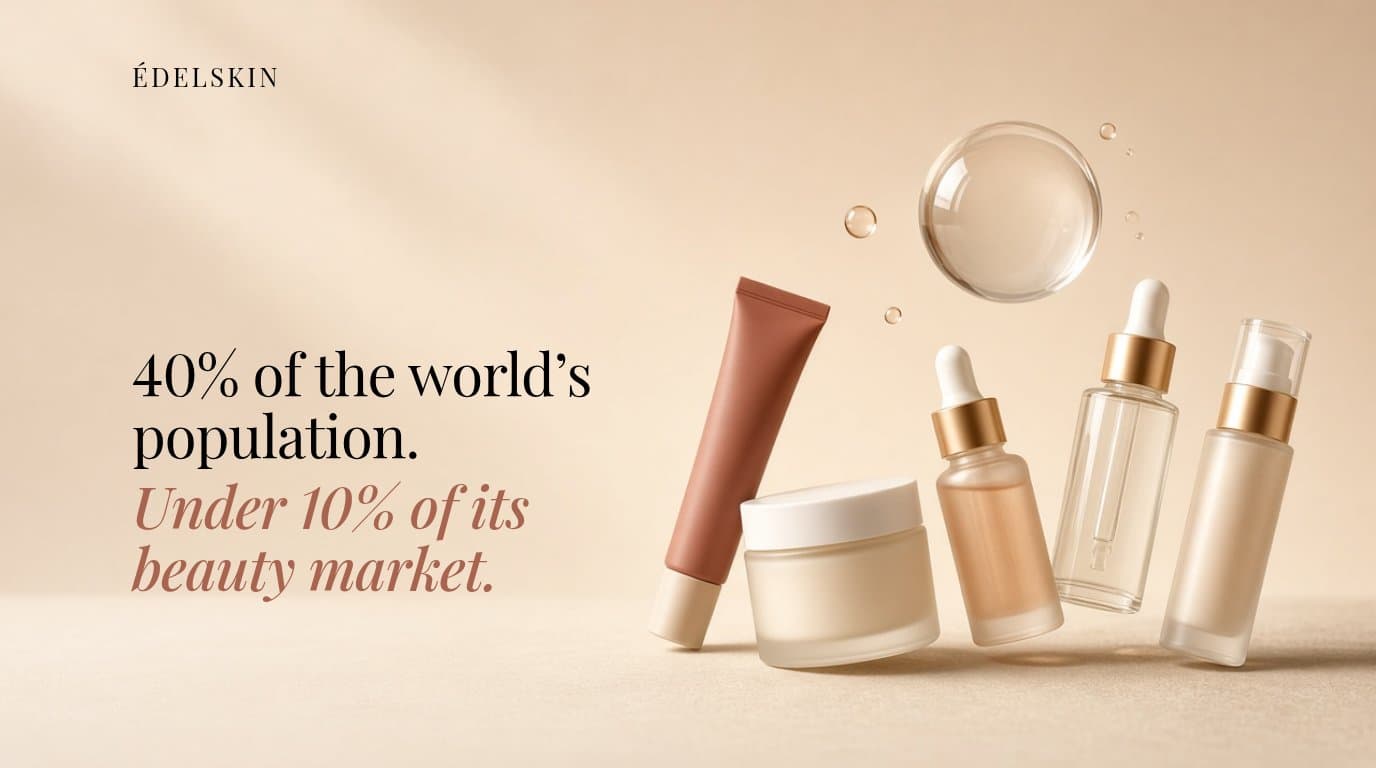
L'Oréal's head for South Asia Pacific, Middle East and North Africa summed up the scale of the gap: the region is home to about 40% of the world's population, but less than 10% of the beauty market. In the same conversation came a line we keep returning to:
"The centre of gravity has not shifted yet, but it is moving."
That's the right way to read this moment. The established markets aren't going anywhere. But the weight of future growth is gradually sliding towards places where many European brands have little or no presence today.
The shelf is becoming a screen
The second shift runs alongside the first. Online accounted for 36% of global skincare sales in 2025 and is projected to reach 40% by 2030. In the fastest-growing markets, the share of discovery that happens on a phone is often higher still, because many consumers there came to beauty through social platforms and marketplaces rather than department stores.
Euromonitor also points to science-backed pharmacy and dermatologist skincare as a bright spot. That matters for European brands in particular. Efficacy, formulation expertise and a credible scientific story are exactly what many of them already have. The question is whether that story can be told, and sold, in a digital environment that moves at a different speed from the one they know at home.
Why the opportunity is harder than it looks
It would be easy to read these numbers and conclude that the answer is simply to show up. In practice, the gap between a promising market and a growing brand is wide.
Winning online in a fast-moving market means understanding how local consumers talk about skin, which platforms they trust, which content earns attention and which falls flat. It means running promotions, reading the data every day and adjusting quickly. None of that can be done well from a head office several time zones away, and none of it is solved by finding someone to hold stock.
This is where many brands reach for the familiar options. A distributor offers reach, but often at the cost of control over pricing, positioning and the customer relationship, which are the things that make a brand worth building. A consultancy offers insight, but leaves the brand to turn a strategy deck into daily results on its own. Neither model is built for markets where the advantage comes from execution.
How we see our role
At ÉDELSKIN, we work as the commercial arm of European cosmetics, hygiene and baby care brands in dynamic markets, from China to the next wave of fast-growing ones. Our view is simple.
We're not a distributor — your brand stays yours. The brand keeps ownership of its products, its data and its customer relationships.
We're not a consultancy — we don't advise, we execute. A dedicated team on the ground handles marketing, social media, data-driven optimisation and daily operations, so the brand's strengths actually reach the consumers who are looking for them.
We believe the brands that gain the most from this shift won't necessarily be the biggest. They'll be the ones that move early, keep control of who they are, and partner with people who can do the work locally.
Moving with the centre
The centre of gravity in beauty hasn't shifted yet. But the direction is clear: growth is concentrating in younger, more digital markets, and in categories where European expertise has a real edge. For European brands, the question is no longer whether these markets matter. It's whether they'll be there, in their own name, when the shift is complete.
Sources
- Euromonitor International, global beauty and personal care market data and outlook, September 2026.
- Euromonitor International, Southeast Asia beauty forecast 2026–2030 and global skincare channel data.
- ETBrandEquity, interview with L'Oréal's head for South Asia Pacific, Middle East and North Africa, September 23, 2026.
- CNBC-TV18, L'Oréal India growth outlook, October 1, 2026.