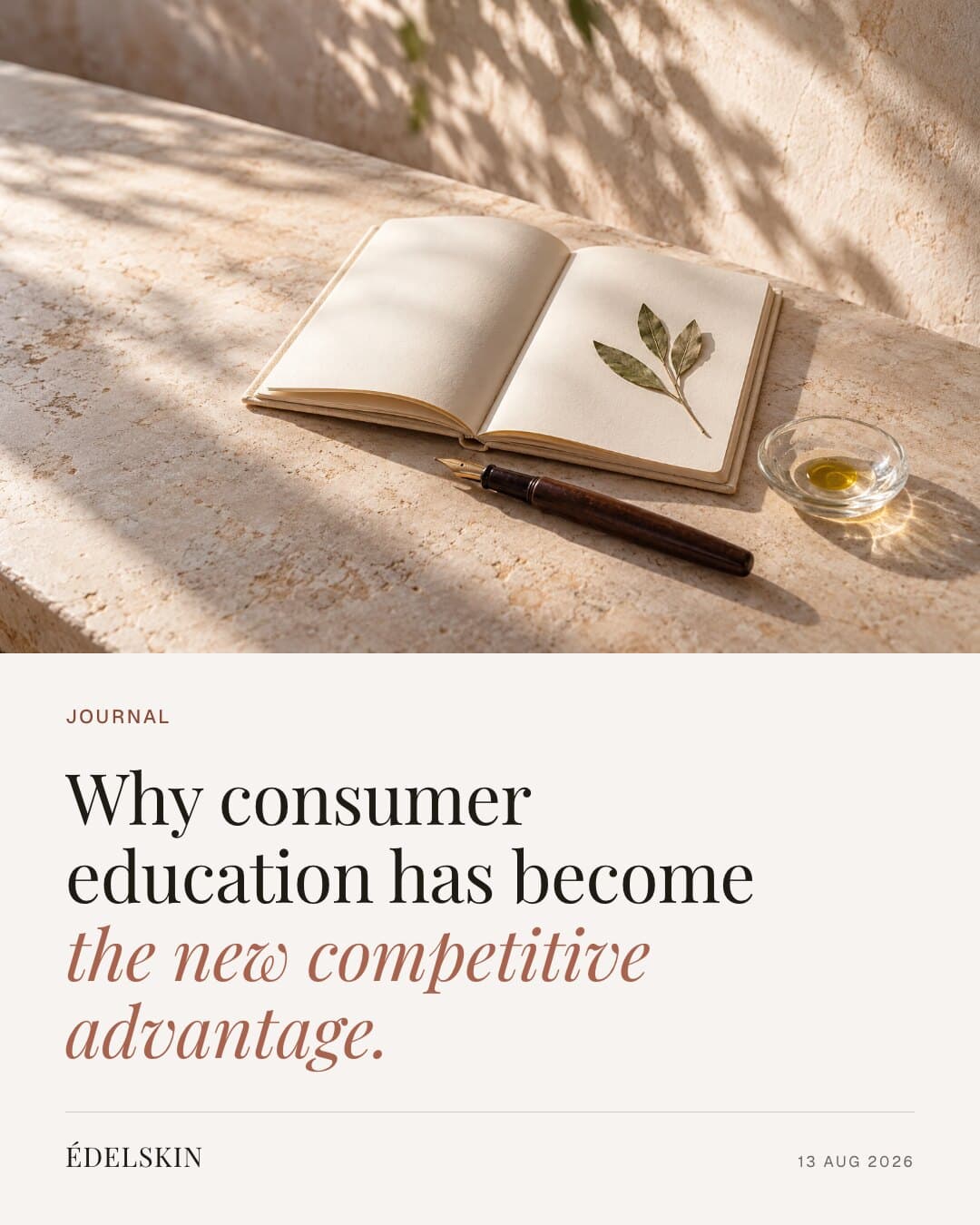
Why Consumer Education Has Become the New Competitive Advantage
As consumers become more informed, the ability to explain the science behind a product is becoming as important as the innovation itself, making education a powerful source of trust and competitive advantage for premium skincare brands.
There was a time when product innovation alone was enough to differentiate a premium skincare brand.
A breakthrough ingredient, an elegant formulation or a compelling marketing campaign could capture consumer attention and establish a lasting position in the market. Information was relatively scarce, purchasing decisions were largely influenced by brand reputation and retailers played an important role in shaping consumer perceptions.
That environment no longer exists.
Today's consumer enters the purchasing journey with access to an unprecedented amount of information. Before making a decision, they compare ingredient lists, read clinical studies, watch dermatologist videos, browse online communities and analyse hundreds of consumer reviews. By the time they purchase a product, many have already formed an opinion about its formulation, its claims and even its scientific credibility.
For premium skincare brands, this represents a fundamental evolution.
Products are no longer evaluated solely by what they promise, but increasingly by how well brands help consumers understand those promises.
In many respects, education has become part of the product itself.
This is not simply a consequence of social media or digital commerce. It reflects a broader transformation in consumer behaviour. As skincare has become more sophisticated, consumers have become more engaged. They are no longer passive recipients of marketing messages but active participants in the decision-making process, seeking evidence, context and understanding before placing their trust in a brand.
The result is a new competitive landscape.
Brands are no longer competing only through formulation, packaging or advertising.
Increasingly, they are competing through knowledge.
From Marketing to Education
For decades, much of beauty marketing focused on aspiration. Campaigns were designed to create emotional desire through beautiful imagery, storytelling and brand identity. While these elements remain essential, they are no longer sufficient on their own.
Today's consumers expect brands to explain as well as inspire.
Why was a particular active ingredient selected?
How does the formulation work?
What evidence supports the claims?
How should the product be incorporated into a skincare routine?
These are no longer niche questions asked by a small group of highly engaged consumers. They have become part of the mainstream purchasing journey.
Perhaps the most successful brands today are not those with the loudest marketing campaigns, but those capable of making complex science accessible without oversimplifying it.
Education has become another form of brand building.
When consumers understand why a product works, they are more likely to trust it. That trust often translates into stronger loyalty, higher repurchase rates and greater willingness to recommend the brand to others.
Trust Is Built Long Before the Purchase
One of the most significant changes in premium skincare is that trust is increasingly established before consumers ever interact with the product.
Many purchasing decisions are now influenced by educational content encountered weeks or even months earlier.
A dermatologist explaining skin barrier function.
A cosmetic chemist discussing formulation stability.
A founder describing the research behind a patented technology.
An aesthetic physician explaining how skincare complements in-clinic treatments.
These moments do not necessarily promote a specific product.
Instead, they establish credibility.
When consumers eventually encounter a brand associated with those voices, the decision often feels less like a leap of faith and more like the natural conclusion of a learning process.
This represents a profound departure from traditional beauty marketing, where advertising frequently created awareness first and trust followed later.
Increasingly, education creates trust before the purchase even begins.
The Rise of Scientific Storytelling
Scientific credibility alone is rarely enough.
Consumers may appreciate clinical evidence, but they also want brands to communicate in ways that feel human, relevant and understandable.
This is where scientific storytelling becomes increasingly important.
The strongest brands are able to translate formulation science into narratives that consumers can relate to without compromising scientific integrity.
Rather than overwhelming audiences with technical terminology, they explain why an ingredient matters, how it addresses a particular skin concern and what consumers can realistically expect from consistent use.
In doing so, they transform science into confidence.
This balance is particularly important for science-led niche brands.
Many possess exceptional research capabilities but struggle to communicate their expertise beyond technical audiences. Conversely, some brands excel at storytelling while offering little scientific substance behind their claims.
The competitive advantage increasingly belongs to those capable of combining both.
What This Means for Heritage Brands
For established brands, consumer education represents an opportunity to reinforce authority rather than defend it.
Many heritage companies possess decades of research, extensive clinical expertise and significant investment in innovation. Yet much of this knowledge has historically remained behind the scenes.
Today's consumers increasingly expect to see it.
Brands that openly explain their research, introduce their scientists, publish clinical data and communicate formulation decisions are strengthening relationships with increasingly knowledgeable consumers.
Heritage remains a powerful asset.
Education allows that heritage to become visible.
Rather than relying solely on reputation built over decades, established brands can continuously demonstrate why that reputation remains deserved.
What This Means for Emerging Brands
For science-led niche brands, education has become one of the most effective ways to compete.
Historically, younger companies often struggled against the marketing budgets of multinational beauty groups.
Today, expertise can travel much further than advertising.
A founder with genuine scientific knowledge, a dermatologist explaining a formulation or a pharmacist discussing ingredient interactions can reach millions of consumers through digital platforms without requiring traditional media investment.
Education has democratised credibility.
It allows specialised companies to compete on expertise rather than scale.
That does not eliminate the importance of branding.
Exceptional science still requires exceptional communication.
Consumers may discover a brand because of its expertise, but they remain because of the overall experience the brand creates.
Education builds confidence.
Branding builds emotional connection.
The most successful companies understand that these are complementary rather than competing strengths.
Beyond Products
Perhaps the most significant consequence of this evolution is that premium skincare brands are becoming knowledge platforms as much as product companies.
Consumers increasingly expect guidance, expert insight and ongoing support throughout their skincare journey.
The relationship no longer ends when a purchase is completed.
Brands are creating educational ecosystems through articles, videos, webinars, founder interviews, dermatologist collaborations, community discussions and personalised guidance.
These initiatives are not simply marketing activities.
They create long-term value.
As consumer expectations continue to evolve, the ability to educate may become as important as the ability to innovate.
Looking Ahead
The future of premium skincare will undoubtedly continue to be shaped by scientific discovery, biotechnology and increasingly sophisticated formulations.
But innovation alone will not determine which brands succeed.
The brands that lead the next decade are likely to be those that make innovation understandable.
They will help consumers navigate increasingly complex choices with clarity, transparency and credibility.
In doing so, they will build something more valuable than awareness.
They will build trust.
And in premium skincare, trust is becoming one of the industry's most enduring competitive advantages.
Sources
McKinsey & Company – The beauty market in 2025: New realities, new opportunities
https://www.mckinsey.com/industries/consumer-packaged-goods/our-insights/the-beauty-market-in-2025-new-realities-new-opportunities
NielsenIQ – Beauty Trends & Consumer Insights
https://nielseniq.com/global/en/insights/consumer-industry/beauty/
Statista – Skincare Market Worldwide
https://www.statista.com/outlook/cmo/beauty-personal-care/skincare/worldwide
Grand View Research – Cosmeceuticals Market Size, Share & Trends Report
https://www.grandviewresearch.com/industry-analysis/cosmeceuticals-market
Mintel – Beauty & Personal Care Market Research
https://www.mintel.com/beauty-and-personal-care-market-research/
Deloitte – Consumer Products & Retail Insights (consumer trust, transparency and digital engagement)
https://www.deloitte.com/global/en/Industries/consumer.html
About ÉDELSKIN
ÉDELSKIN is an international commercialisation company helping beauty, wellness and healthcare brands enter and grow in Asia’s consumer markets. It works as the brand’s direct-to-consumer commercial arm, and the brand keeps full ownership and control.
How ÉDELSKIN works